
The Problem With Pure Automation
The security technology industry has spent the last decade making a compelling promise: install AI, connect your cameras, and let the algorithm handle the rest. No staffing overhead. No human error. Just continuous, automated threat detection at scale.
It is a seductive pitch. And in controlled conditions, the technology genuinely performs. Modern computer vision systems can identify the outline of a firearm or edged weapon with impressive consistency — faster than any human observer, across more camera feeds simultaneously than any team could monitor.
But the pitch omits something critical: what happens after the detection.
Automated systems that generate alerts without human review create a specific and well-documented problem. Security researchers and practitioners have a name for it: false alarm fatigue. When a security team receives a stream of automated alerts — and a meaningful proportion of those alerts turn out to be non-threats — something predictable happens. Response times slow. Confidence in the system erodes. Eventually, operators begin to treat the alert channel as background noise rather than actionable intelligence.
This is not a hypothetical failure mode. It is what happened with first-generation automated systems in retail loss prevention. It is what happened with early building access control systems. And it is what is beginning to happen with some weapon detection deployments today, particularly those built on the assumption that AI confidence scores alone are sufficient to trigger a response.
The core problem is that no AI system operates with perfect precision in real-world conditions. Lighting changes. Camera angles shift. Objects are carried in unusual ways. A power tool in a car park. A phone held at a certain angle. A prop from a theatre production being loaded into a venue. Each of these can produce a detection event that a competent human reviewer would dismiss in seconds — but that an automated system will escalate with the same urgency as a genuine threat.
What Human Verification Actually Means
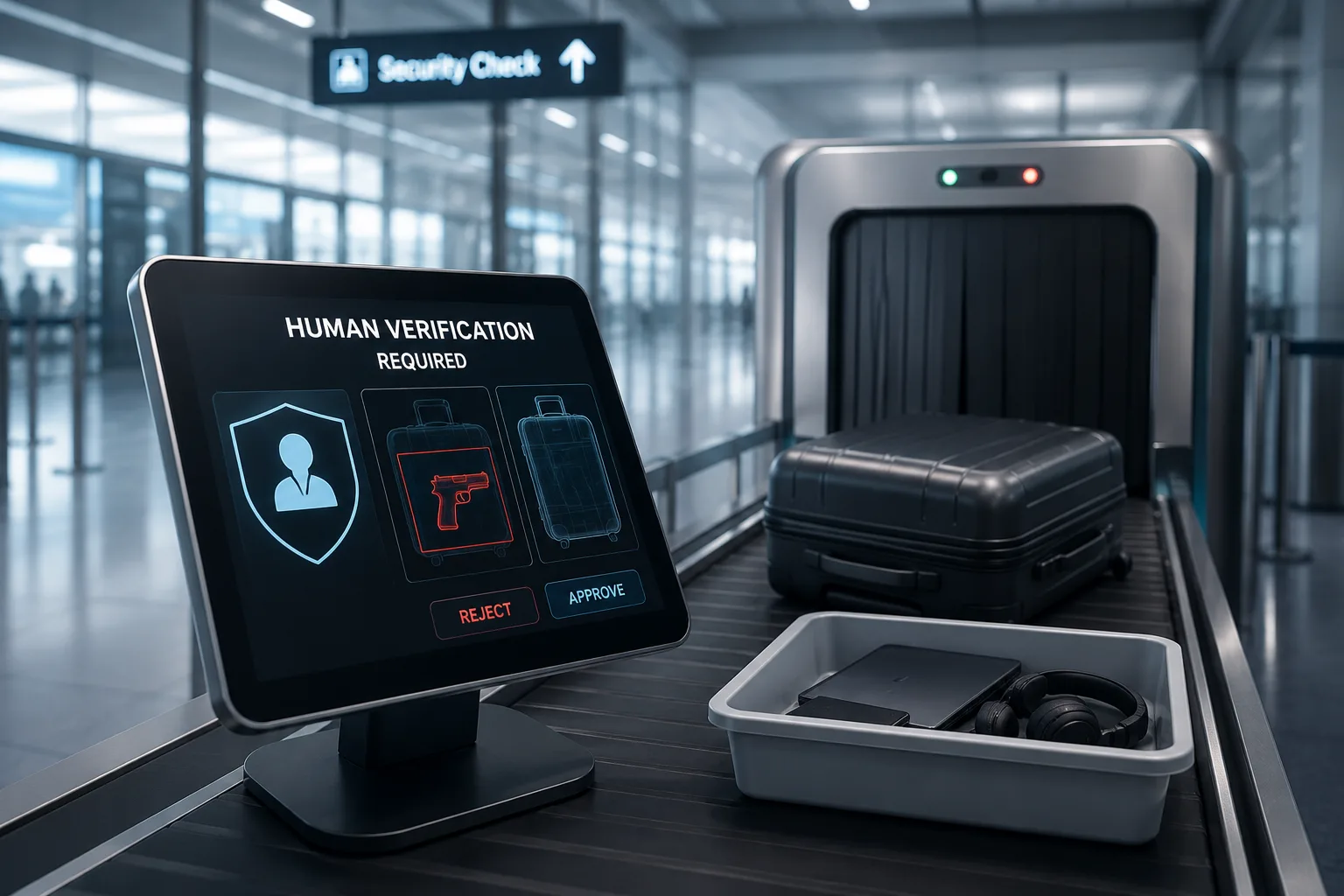
At First Cordon, human verification is not a backup system or a slow lane. It is the architecture.
Every AI detection event generated by the Threat Mitigation System™ is reviewed by a trained First Cordon operator before any alert reaches your security team. The process works like this: the AI identifies a potential threat within the camera feed and flags it for immediate human review. The operator — working within a defined verification protocol, trained specifically in threat identification — reviews the detection in real time, with full access to the camera view, the detection timestamp, and relevant site context.
If the operator confirms the detection as a credible threat, your team receives a verified alert. That alert includes the specific location within your site, visual confirmation of the threat, and the information your team needs to respond confidently and quickly.
If the operator does not confirm the detection — if the review determines it is a non-threat — nothing reaches your team. You are not interrupted. Your security personnel are not deployed unnecessarily. And critically, your team's confidence in the alert channel is preserved for the moments when it genuinely matters.
This distinction matters enormously in practice. A security team that receives ten verified alerts per year and responds to every one of them is in a fundamentally different position than a team that receives five hundred automated alerts per year and has learned to treat most of them as noise. The verified alert system maintains response readiness. The automated alert system erodes it.
The Speed Question
A common and reasonable objection to any human-in-the-loop system is the speed question. Does adding a human review step introduce meaningful delay? And if so, does that delay create risk?
It is worth being precise about what the alternatives actually look like. A fully automated alert that reaches your security team and turns out to be a false positive does not save time. It costs time twice: once for the response to the non-threat, and once for the compounding erosion of confidence that makes future responses slower and more hesitant.
A verified alert that arrives with confirmed threat intelligence — specific location, visual confirmation, operator assessment — enables a faster and more purposeful response. Your people know what they are moving toward before they move. That is not a small advantage. In a high-stakes environment, the difference between a team that is reacting to a confirmed threat and a team that is tentatively investigating an unverified one can be measured in outcomes.
First Cordon's verification process is designed to operate at the speed the situation demands. Human operators are trained to make fast, accurate assessments. The system is built around minimising the time between AI detection and verified alert delivery — not eliminating the human step, but making that step as fast as possible without compromising its accuracy.
The Trust Architecture
There is a broader point here that goes beyond the operational mechanics of any individual alert. The relationship between a security team and its tools is built on trust. When a tool performs reliably — when it delivers accurate, actionable intelligence consistently — that trust deepens, and the team becomes more effective. When a tool delivers noise, that trust erodes, and the team becomes less effective even as the tool continues to generate output.
Human verification is, at its core, a trust architecture decision. It is a choice to prioritise the accuracy and reliability of each alert over the raw volume of detections. It is a choice to keep your security team in a state of readiness rather than alert fatigue. And it is a choice that reflects a particular view of what security technology is actually for — not to replace human judgment, but to augment it with intelligence that humans can act on with confidence.
The ANZ Context
First Cordon operates across New Zealand, Australia, and the United States, and the human verification layer takes on specific significance in the ANZ context.
New Zealand and Australia have well-established expectations around the proportionality of security responses. An unnecessary lockdown at a school, triggered by an automated false positive, carries significant consequences — for the students and staff involved, for the institution's relationship with its community, and for the regulatory environment that governs security practices in educational settings. A false alarm at a hotel during a high-profile event carries reputational risk that extends well beyond the immediate disruption.
In environments where the consequences of over-response are real and significant, the human verification layer is not just a technical feature. It is a commitment to the communities, institutions, and organisations that rely on First Cordon to get this right.