
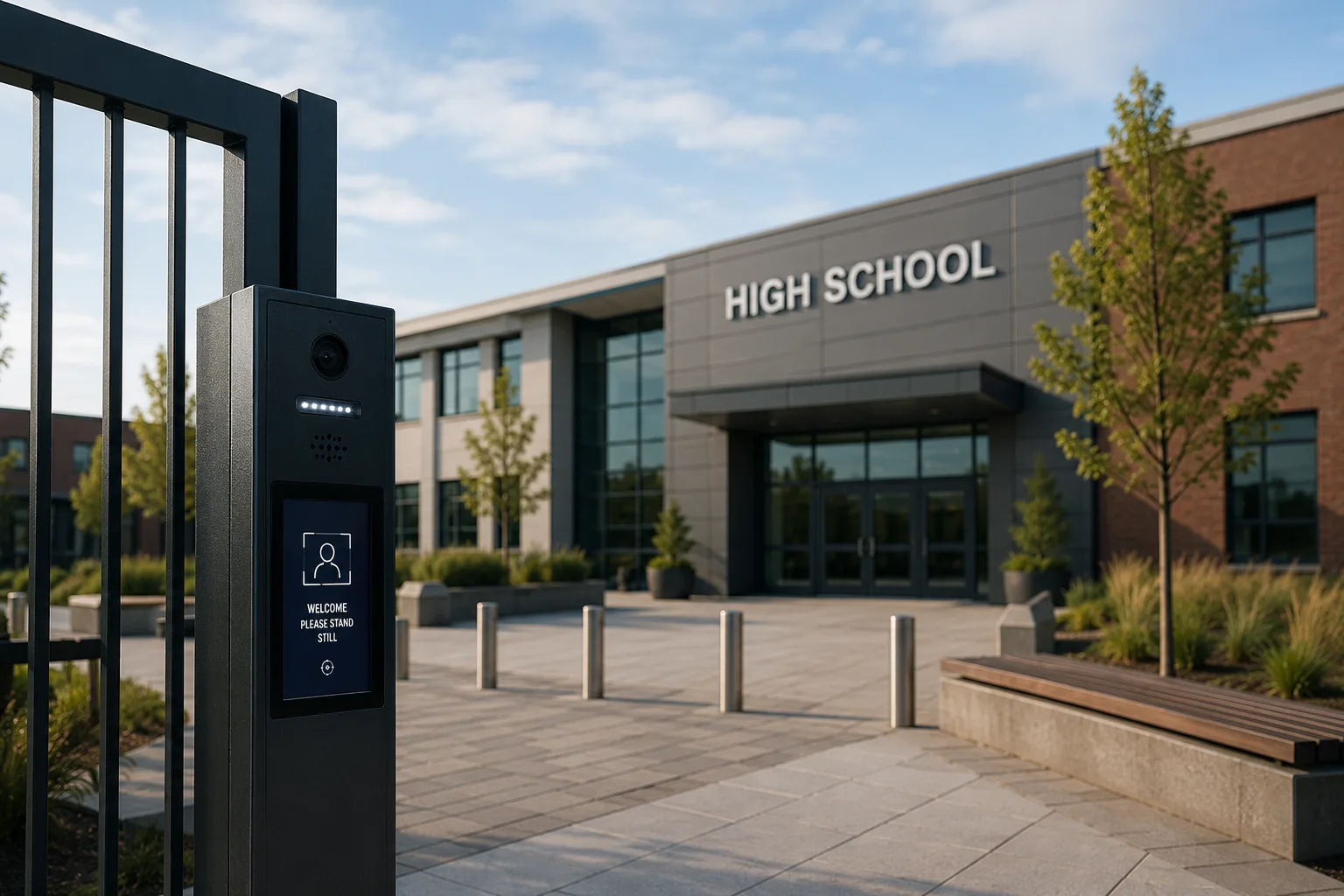
The Fundamental Tension in School Security
Every school security conversation eventually arrives at the same tension. On one side: the genuine and growing need to protect students, staff, and visitors from the possibility of a weapons-related incident. On the other: the equally genuine need to preserve the character of a school as an open, welcoming, educationally-focused environment.
These two imperatives pull in opposite directions, and the security measures that would most obviously address the first tend to most obviously undermine the second.
Metal detector screening at every entrance is the most commonly proposed solution to the open campus problem. It is also the most disruptive. A screening point creates a queue. A queue creates a bottleneck. A bottleneck, in a school environment, creates supervision challenges, late arrivals, and a daily ritual that communicates — loudly and visibly — that the institution does not feel safe. The psychological impact of that signal on students, particularly younger ones, is significant and largely negative.
Bag checks and manual inspection face the same fundamental problem at greater scale. They require staffing that most schools cannot sustain. They create friction that accumulates across hundreds of daily entry events. And they are, inevitably, inconsistent — the volume of people moving through a school on any given day makes thorough manual inspection practically impossible.
The honest assessment is that traditional screening was designed for environments that have something schools do not: a single, controlled entry point and a tolerance for queuing. Airports work because passengers expect to queue, because the single-entry model is part of the air travel architecture, and because the security theatre itself serves a specific deterrence and compliance function. Schools are not airports. They should not be.
Why Passive CCTV Is Not Enough
Most schools in New Zealand and Australia have CCTV systems installed. These systems are a standard part of the security infrastructure, and they serve important purposes — deterrence, post-incident review, evidence collection.
What they do not do, in their standard configuration, is detect threats in real time.
A passive CCTV system records what happens. It does not identify what is happening as it happens. If a person carrying a visible weapon enters a school through any of its multiple access points, the CCTV system will capture that footage. It will not alert anyone to the fact that it is happening until a human reviewer watches that footage — either during a monitoring cycle, or after the event.
In a threat context, the gap between detection and alert is the most dangerous period of any incident. The value of a weapon detection system lies precisely in its ability to close that gap — to identify a visible threat at the moment it appears, rather than confirming it was there in the footage review that follows.
AI-assisted detection, operating through your existing cameras, closes that gap. It converts passive surveillance infrastructure into active threat intelligence infrastructure without requiring a new camera network, without creating visible security checkpoints, and without changing the daily experience of students and staff moving through the school.
What Verified Detection Looks Like in a School Context
When TMS™ is deployed across a school campus, it monitors the camera feed continuously — across all zones, at all times, including periods when the school is not in session. If a visible weapon appears anywhere within the camera network, the AI detection triggers immediately.
That detection is then reviewed by a First Cordon human operator. This review step is especially important in a school context, because the consequences of a false alert in an educational environment are uniquely significant.
An unnecessary lockdown at a school does not simply inconvenience the staff. It frightens students. It pulls teachers away from their classrooms. It triggers communication with parents, who will have questions and concerns that need to be managed carefully. It has an aftermath that extends well beyond the duration of the false alarm itself — in some cases, affecting student wellbeing and community trust for days or weeks.
Human verification eliminates the false alarm problem at its source. If the detection is not confirmed as a genuine threat by a trained operator, nothing reaches your school. There is no lockdown. There is no disruption. There is no aftermath to manage.
If the detection is confirmed, your designated security contacts receive a verified alert with location information and visual confirmation. Your response protocol — established during the deployment briefing and tailored to your specific campus — guides what happens next.
Establishing the Right Response Protocol for a School
A school's response to a verified weapon alert is different from the response of a hotel or a transport hub. The population at risk is primarily children. The communication requirements are more complex. The relationship with parents and caregivers creates obligations that do not exist in commercial environments.
First Cordon works with school leadership during the deployment process to establish a response protocol that reflects these realities. Who receives the verified alert? In most cases, this is the principal or deputy principal, the school's designated safety officer, and a nominated liaison to the local police. The alert delivery channel — phone, SMS, email, or a combination — is configured to reach these people simultaneously, without requiring one person to cascade the notification through a chain.
The protocol also addresses the question of partial response. Not every alert will require a full school lockdown. If a verified detection occurs in an area of the campus that can be isolated — a car park, a perimeter zone, an external building — the response may be more targeted, protecting students without triggering the full lockdown communication that has its own costs.
These decisions are made in advance, in consultation with school leadership and with input from First Cordon's team, which has experience across a range of educational environments. They are documented and reviewed periodically to ensure they remain current as the school's operational context changes.
Integration with Existing Security Arrangements
Most schools already have some form of security arrangement in place — whether that is a security provider, a relationship with local police, or a combination of staff responsibilities and protocols. TMS™ is designed to integrate with these existing arrangements, not to replace them.
The system adds a layer of continuous, AI-assisted detection that extends beyond what human observers can provide. It does not require changes to your existing security staffing or your relationship with your security provider. It does not require your staff to monitor an additional system or respond to a new alert interface — the verified alerts are delivered through the same channels your team already uses.
What changes is the quality and timeliness of the threat intelligence available to your team. When an alert arrives, it arrives verified, located, and with visual confirmation. Your team responds with information, not uncertainty.
The ANZ School Security Context
New Zealand and Australian schools operate within a specific regulatory and community context that shapes what responsible security looks like. The Ministry of Education in New Zealand has published guidance on school safety that emphasises proportionality, community engagement, and the importance of avoiding measures that create fear or stigma without meaningfully improving safety.
First Cordon is the only locally-supported weapon detection provider operating in ANZ. This means that when you are making decisions about how TMS™ fits within your school's broader safety framework — how to communicate it to parents, how to integrate it with your emergency management planning, how to report on it to your board — you are working with people who understand that context, who operate within the same regulatory environment, and who are available in your timezone when you need them.