
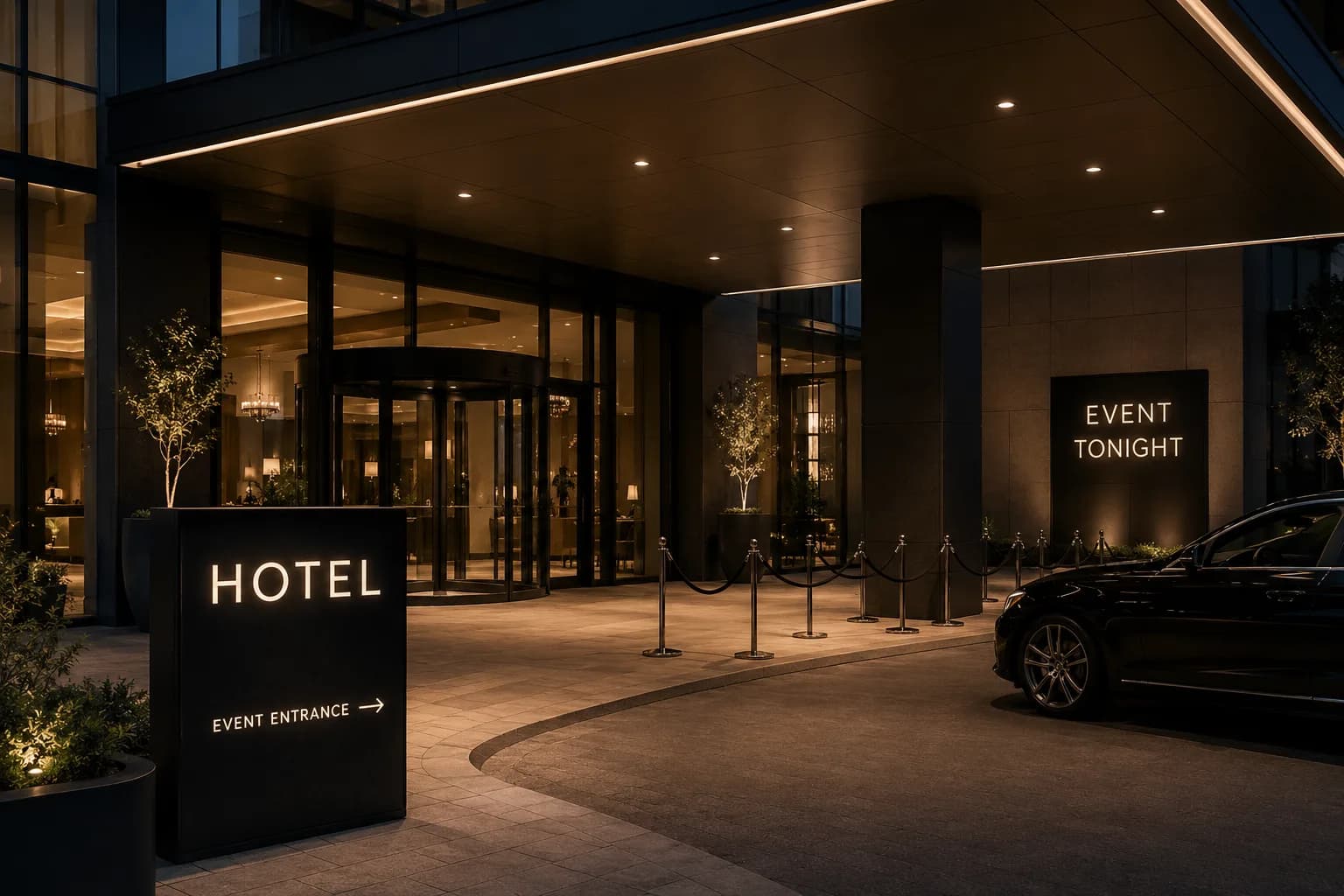
The Paradox at the Heart of Hospitality Security
There is a tension built into the security brief of every hotel, resort, and event venue that does not exist in most other environments. Security in these settings must be simultaneously rigorous and invisible. It must be robust enough to respond effectively to a genuine threat, but discreet enough that guests never feel they are being screened, monitored, or assessed as potential risks.
This is not a new challenge. The hospitality industry has been managing it for decades through a combination of trained staff observation, discreet CCTV, and the careful positioning of security personnel in a way that reads as service rather than enforcement. A well-trained concierge team notices more than most guests realise. Lobby design is often deliberately structured to create natural observation points. The environment itself is part of the security architecture.
But this approach has limits that become particularly visible in two circumstances: during high-profile events, and in large or complex properties where the sheer scale of the environment exceeds what human observation alone can comprehensively cover.
The Event Risk Window in Detail
High-profile events — product launches, award ceremonies, political functions, large corporate conferences, social occasions with public figures in attendance — represent a qualitatively different security environment from the baseline hotel operation.
Several factors converge to create elevated risk during these periods. The first is profile: events with public figures, prominent organisations, or significant media attention are more likely to attract individuals with hostile intent. The second is volume: events bring large numbers of people into a compressed space over a compressed time period, creating crowds that are inherently more difficult to observe comprehensively. The third is distraction: the operational demands of event management — logistics, guest relations, vendor coordination, AV management — pull staff attention toward the event itself rather than the security environment.
The fourth factor is perhaps the most consequential: during events, the normal patterns of movement and behaviour at a hotel change significantly. Guests who would normally pass through the lobby individually may arrive in large groups. Areas that are normally quiet may become busy. Staff who would normally be alert to unusual behaviour are often absorbed in event service.
This is the window in which traditional human observation is most likely to fail. Not because the staff are not doing their jobs, but because the environment has changed in ways that reduce the effectiveness of observation-based security.
Invisible Integration with Existing Infrastructure
First Cordon's TMS™ is specifically designed for the operational constraints of the hospitality environment. The most important design principle, from a guest experience perspective, is that it requires no visible new hardware in guest-facing areas.
The system connects to the IP camera network that most hotels and venues already operate. Lobby cameras, restaurant and bar cameras, conference suite cameras, and corridor cameras — all of which are standard in modern hotel infrastructure — become the sensor layer for continuous AI-assisted threat detection. From a guest's perspective, nothing has changed. They see the same environment they have always seen. There are no new scanners at the entrance, no visible detection hardware in the lobby, no security theatre that communicates risk at the moment of arrival.
This is the invisible security model that hospitality environments require, and it is achievable without compromise on detection capability. The cameras that are already there, connected to TMS™, provide comprehensive coverage of the zones that matter most — entry points, public areas, event spaces — without any of the visible measures that would undermine the guest experience.
The Human Verification Advantage in Hospitality
In a hospitality environment, the cost of a false alert is particularly high. An unnecessary security response in a hotel lobby during a function is not a minor inconvenience. It is a visible disruption to the guest experience, a potential source of significant reputational harm, and in some cases — particularly where high-profile guests or media are present — a story that extends beyond the hotel's walls.
The human verification layer that sits at the core of TMS™ is, in a hospitality context, as much a brand protection mechanism as it is an operational one. Every detection that enters the system is reviewed by a trained First Cordon operator before any alert reaches your security team. Detections that do not meet the threshold for a verified alert — the vast majority, in a well-configured deployment — are handled entirely within the monitoring system. Your security team, your event staff, and your guests are unaffected.
When a verified alert is issued, it reaches your nominated security contacts with precise location information and visual confirmation. The response can be managed discreetly — your team knows where to go, what they are responding to, and how to get there without creating a visible disturbance in the guest environment.
Multi-Zone Coverage in Complex Properties
Hotels and resorts often present some of the most complex monitoring environments of any venue type. A large city hotel might span thirty floors, multiple food and beverage outlets, a conference centre, a spa, underground car parking, and multiple entry and exit points. A resort might cover tens of hectares across multiple buildings.
TMS™ is designed to handle this complexity. The system monitors multiple simultaneous camera feeds across all zones, without the diminishing coverage that characterises human observation across large environments. A human security team, however well-deployed, will always have moments where coverage thins — when multiple team members are engaged elsewhere, when the shift change creates a brief gap, when an incident in one area draws attention away from another.
AI-assisted detection does not have these gaps. The monitoring is continuous across all connected camera feeds, at all times. At 3am in the car park. During the busiest moment of a conference session. During the shift change. The coverage is consistent because it is not dependent on human attention.
For multi-property operations — a hotel group with properties in Auckland, Sydney, and Melbourne — the TMS™ deployment scales across sites through a unified account structure. Each property has its own monitoring configuration and alert delivery setup, but they are managed through a single account relationship with First Cordon. Adding a new property to the monitoring network follows the same deployment process without requiring a new operational relationship.
Preparing Your Security Team for Verified Alerts
The transition from passive CCTV observation to active, verified threat intelligence requires some adaptation from your security team. The nature of the alerts they receive is different. Rather than observing footage and making their own assessments, they receive verified detections with operator-confirmed threat intelligence. The response protocol changes accordingly.
First Cordon works with your security management team during the deployment process to establish alert delivery procedures, response protocols, and escalation chains that fit your specific operation. Who receives the initial alert? What is the secondary escalation if the primary contact does not respond? How does the alert integrate with your existing radio communication or incident management systems?
These decisions are made before the system goes live, documented clearly, and reviewed periodically. The goal is to ensure that when a verified alert arrives — which, in a well-operating deployment, will be a relatively rare event — your team responds with confidence and without hesitation.
The Local Support Difference
For New Zealand and Australian hospitality operators, the local presence of First Cordon's support team is a material operational advantage. When an incident occurs, or when your operational context changes in ways that affect your security configuration, you are working with people who are based in your region, who operate in your timezone, and who understand the specific regulatory and reputational environment of the ANZ hospitality sector.
Global security technology providers typically offer remote support from offshore centres. The practical experience of working with them during an incident or through a significant operational change is rarely the same as working with a locally-based team that knows your property, knows your team, and is available when you need them.
First Cordon's account management model is built around this local relationship. Your account contact knows your property. They have reviewed your site assessment. They were part of the deployment process. When you call, you are not explaining your situation from scratch to a remote operator reading from a screen. You are speaking with someone who understands your context and can respond to it.